What is a Data Analytics Platform, and Why Is It Non-Negotiable for Business Leaders Today?


In today’s hyper-competitive landscape, merely collecting data is a relic of the past. A data analytics platform is a sophisticated, integrated software solution designed to ingest, process, analyze, and visualize vast amounts of operational data, transforming raw information into actionable insights that drive strategic business decisions. It’s the engine that powers your understanding of “what happened,” “why it happened,” and crucially, “what will happen next.”
As a Senior Content Strategist who has navigated the trenches of countless digital transformations, I’ve seen firsthand the pivotal shift in how leading organizations approach data. The days of siloed spreadsheets and endless manual reports are behind us. For business operations leaders and decision-makers, understanding what a data analytics platform entails isn’t just about technical literacy; it’s about competitive survival.
Why Are Traditional Data Approaches Failing Operations Leaders?
For too long, the promise of “data-driven” decision-making has been hampered by fundamental flaws in how businesses handle information. You might be making this mistake yourself right now, wrestling with fragmented data sources and a reliance on overtaxed IT teams.
Consider this common scenario: Your marketing team needs to understand campaign ROI, your customer success team wants to predict churn, and your sales operations needs to identify “who, why, and when” a deal might close. Each of these critical queries often requires exporting data from disparate systems – CRM, ERP, marketing automation – then wrangling it in spreadsheets, perhaps running some basic pivots, and finally, crossing your fingers that the data is accurate and up-to-date. This isn’t analysis; it’s an arduous, error-prone data assembly line.
We call this the “black box” problem. Data enters the system, but getting meaningful answers out requires specialized SQL knowledge, weeks of waiting for reports, and often, an imperfect understanding of the underlying business context. This bottleneck isn’t just frustrating; it’s crippling. It leads to missed opportunities, inefficient resource allocation, and a constant state of reactive decision-making. Are you truly leveraging your data, or just collecting it?
This is precisely why companies like Scoop Analytics built solutions such as Scoop Self-Service. They recognized that operational leaders and analysts don’t have time to wait. They need to connect their data, ask a question, and generate an answer “in minutes — no SQL, no waiting.” This radical democratization of data is essential because the speed of insight directly correlates to the speed of action. In a market that moves at lightning pace, can you afford to be slow?
What Defines a Modern Data Analytics Platform?
A modern data analytics platform is far more than just a collection of dashboards. It’s a comprehensive ecosystem designed to deliver true operational intelligence. Think of it less like a single tool and more like a sophisticated refinery that takes raw crude oil (your data) and transforms it into refined, usable products (actionable insights).
Is It Just a Dashboard? Understanding Key Components.
To truly understand what a data analytics platform offers, let’s break down its essential components:
1. Data Ingestion & Integration: This is where the platform connects to all your diverse data sources – CRMs, ERPs, marketing platforms, customer support tickets, financial systems, IoT devices, and external datasets. A robust platform provides native connectors and APIs to pull data seamlessly, regardless of its format or origin.
2. Data Transformation & Modeling: Raw data is often messy, inconsistent, and incomplete. This component cleans, structures, and organizes the data, applying business rules and logic to create a unified, reliable dataset ready for analysis. It’s about turning chaos into order.
3. Analytics & Visualization: This is where the magic happens for most users. Tools for querying, reporting, dashboarding, and ad-hoc analysis allow users to explore data visually. Interactive dashboards, charts, and graphs translate complex data into easily digestible formats, making trends and anomalies immediately apparent.
4. Advanced Capabilities (AI/ML & Predictive Analytics): This is the frontier where modern platforms truly differentiate themselves. Artificial intelligence and machine learning algorithms can uncover hidden patterns, forecast future trends, recommend actions, and even detect anomalies before they become problems. This moves you from understanding “what happened” to predicting “what *will* happen.”
5. Scalability & Security: Handling ever-growing volumes of data securely is paramount. A top-tier analytics platform is built for enterprise-grade performance, capable of scaling on demand, and incorporates robust security measures to protect sensitive information.
How Do Cloud Analytics Platforms Drive Agility and Scalability?
The overwhelming majority of modern data analytics platforms are built on cloud infrastructure. These cloud analytics platforms offer unparalleled advantages that are simply unattainable with traditional on-premise solutions.
Elastic Scalability: Need to process petabytes of data during a peak season? Cloud platforms can instantly provision the necessary compute and storage resources, then scale back down when demand subsides. You pay only for what you use, avoiding massive upfront hardware investments.
Accessibility & Collaboration: Because the platform lives in the cloud, authorized users can access it from anywhere, on any device. This fosters collaboration across teams and geographies, breaking down traditional data silos.
Reduced IT Overhead: Cloud providers manage the underlying infrastructure, security, and maintenance, freeing your internal IT team to focus on strategic initiatives rather than server upkeep.
Faster Deployment: Getting a cloud analytics platform up and running can take a fraction of the time compared to on-premise solutions, accelerating your time to insight and value.
This agility is why organizations are rapidly migrating to cloud analytics platforms. The ability to adapt, grow, and secure data effectively is no longer a luxury; it’s a fundamental requirement for any business aiming to stay competitive.
How Does a Data Analytics Platform Actually Empower Operations? (Practical Evidence)
Let’s move beyond the theoretical and look at how a robust data analytics platform empowers various operational functions. This is where the rubber meets the road for operations leaders and decision-makers.
What Does It Look Like in Marketing Operations?
Marketing teams are awash in data – website analytics, campaign performance, CRM data, social media engagement. Without a unified view, correlating spend to actual ROI is a nightmare.
The Problem: Disconnected data makes it difficult to attribute leads and sales accurately to specific campaigns. You’re running campaigns, but you’re guessing at their true impact.
The Platform Solution: A data analytics platform integrates all marketing data sources. You can track customer journeys from first touch to conversion, analyze which channels deliver the highest-value customers, and optimize budget allocation in real-time.
Scoop in Action: Scoop Analytics is designed to “turn marketing data into insights—without manual reports.” Imagine a marketing leader wanting to know: “Which ad creative drove the most qualified leads last quarter in the EMEA region?” With Scoop Self-Service, they connect their ad platforms and CRM, type in the question in plain English, and receive an instant, visual answer.
Action Sequence:
1. Connect: Scoop integrates with Google Ads, Facebook Ads, Salesforce.
2. Ask: A marketing ops leader queries, “Show me lead acquisition cost by channel for Q3 in Europe.”
3. Analyze: The platform immediately presents a dynamic dashboard highlighting the most cost-effective channels and underperforming ones.
4. Act: The leader reallocates budget from underperforming channels to those with proven ROI, potentially saving thousands and boosting qualified lead volume by 15% in the next cycle.
How Can It Revolutionize Customer Success?
Customer success is no longer just about reacting to problems; it’s about proactively ensuring customer satisfaction and retention. Data holds the key to this foresight.
The Problem: Identifying at-risk customers often relies on anecdotal evidence or lagging indicators like missed payments. By then, it might be too late.
The Platform Solution: A data analytics platform pulls together usage data, support ticket history, survey feedback, and contractual information. AI-driven analytics can then predict churn likelihood, highlight upsell opportunities, and identify features that correlate with high satisfaction.
Scoop in Action: Scoop helps “drive renewals and upsells with AI analytics.” Consider a customer success manager asking, “Which of my enterprise accounts with declining product usage are due for renewal in the next 90 days?” Scoop’s AI can process product telemetry alongside contract data to provide a prioritized list.
Action Sequence:
1. Integrate: Scoop connects to product usage data, CRM, and customer support systems.
2. Predict: The platform’s AI identifies accounts exhibiting patterns common among churned customers (e.g., decreased login frequency, ignored feature adoption).
3. Proact: Customer Success receives an alert with a ‘churn risk score’ for specific accounts.
4. Engage: They initiate a proactive outreach, offering tailored support or highlighting underutilized features, successfully retaining 10 high-value customers, avoiding $500,000 in lost revenue.
What About Sales Operations and Revenue Growth?
Sales operations leaders are constantly looking to optimize pipeline, improve forecasting, and understand sales performance drivers. Without centralized intelligence, this is a monumental task.
The Problem: Fragmented CRM data and reliance on manual reporting leads to inaccurate sales forecasts, misunderstood pipeline health, and an inability to pinpoint “who” is selling well, “why” certain deals are won or lost, and “when” they are most likely to close.
The Platform Solution: A data analytics platform unifies CRM data, sales activities, and even external market data. It provides drill-down capabilities into individual rep performance, territory effectiveness, and identifies patterns in successful deal closures.
Scoop in Action: Scoop Analytics “transforms CRM Data Into Clear Who, Why, and When Answers.” Imagine a VP of Sales asking, “Which sales reps consistently achieve quota on deals above $100k, and what common activities do they perform at the ‘negotiation’ stage?” Scoop can analyze thousands of CRM records to provide those precise answers.
Action Sequence:
1. Centralize: Scoop ingests all CRM data (Salesforce, HubSpot, etc.) including call logs, emails, and deal stages.
2. Analyze: The platform identifies top-performing reps, correlating their activities (e.g., number of discovery calls, specific demo scripts) with successful large deal closures.
3. Strategize: Sales leadership uses these insights to refine sales playbooks and targeted training programs.
4. Optimize: As a result, average deal size increases by 8%, and the sales cycle shortens by 5 days over the next quarter.
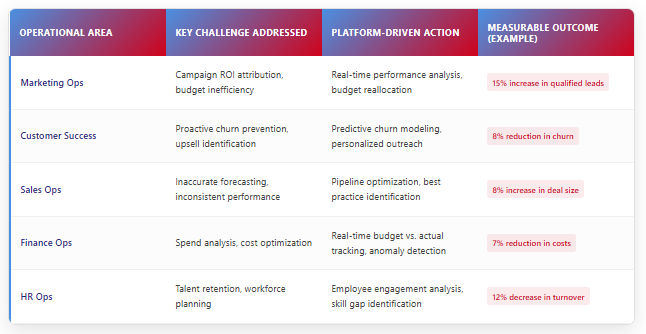
Here’s a snapshot of how a data analytics platform creates tangible impact across common operational areas:
Beyond Reactive Reporting: The Future of Analytics Platforms.
For many organizations, even having comprehensive dashboards feels like a win. But what if your analytics platform could do more than just answer the questions you *ask*? What if it could tell you what you *should* be asking, or even what you didn’t know to ask for?
Why Is Proactive Intelligence Critical for Executives?
Executives and senior leaders are drowning in data, yet starved for critical insights. They need to understand not just the current state but the future implications of trends and anomalies. Waiting for an analyst to manually compile reports means insights arrive too late to inform agile decision-making.
This is where the next generation of analytics platform technology comes into play. Scoop Domain Intelligence, for instance, is an “autonomous investigation engine for executives.” Its power lies in its ability to “continuously surface insights you didn’t know to ask for.” Imagine a system that’s constantly analyzing your entire business domain, identifying emerging patterns, uncovering hidden correlations, and flagging potential risks or opportunities – all before you’ve even formulated the question. This shifts the executive mindset from reactive inquiry to proactive strategy, providing a significant competitive edge. What if your analytics platform could tell you what’s coming around the corner?
Can Analytics Become a Customer-Facing Asset?
Traditionally, data analytics has been an internal function, empowering your teams. But what if you could extend these insights directly to your customers, enriching their experience and strengthening your value proposition?
Scoop Embedded Agents illustrate this innovative future. These are “embedded analytical agents that deliver insights to each customer.” Think about the potential:
For a SaaS product: Your customers could receive personalized performance benchmarks, usage recommendations, or alerts based on their own data, directly within your application.
For a financial service: Clients could get tailored spending insights or investment performance analyses without ever leaving your portal.
For an e-commerce platform: Customers could receive intelligent recommendations or insights into their purchasing patterns that drive loyalty.
By pushing relevant, personalized insights directly to the end-user, you transform your internal data intelligence into a tangible, value-added service for your customers. This isn’t just about operational efficiency; it’s about innovating your product and customer experience. It elevates your company from merely selling a product or service to providing ongoing, intelligent value.
Key Term Definitions:
Data Analytics Platform: An integrated software solution that connects to various data sources, processes and transforms raw data, enables analysis through interactive dashboards and reports, and often includes advanced AI/ML capabilities to extract actionable insights for business decision-making.
Cloud Analytics Platform: A data analytics platform hosted and managed by a third-party provider on cloud infrastructure. It offers scalable compute and storage resources, high accessibility, and reduced IT overhead compared to traditional on-premise solutions, allowing businesses to analyze data flexibly and cost-effectively.
Business Intelligence (BI): A set of strategies, processes, and technologies used for analyzing business information. BI focuses on descriptive analytics—understanding past and present data—to provide insights into business performance. A data analytics platform typically encompasses and extends traditional BI capabilities with more advanced features.
AI Analytics: The application of artificial intelligence and machine learning techniques within a data analytics platform to automate data processing, uncover complex patterns, predict future outcomes, and provide prescriptive recommendations. This moves beyond human-driven queries to autonomous insight generation.
FAQ Section:
Q: What’s the difference between a data warehouse and a data analytics platform?
A: A data warehouse is primarily a repository—a centralized store for structured data, optimized for complex queries. Think of it as the highly organized library. A data analytics platform, on the other hand, *uses* the data warehouse (or other data stores) as its foundation but goes further by providing the tools for data ingestion, transformation, analysis, visualization, and advanced AI capabilities to extract actionable insights. It’s the AI-powered librarian, research assistant, and presentation designer all rolled into one.
Q: How long does it take to implement an analytics platform?
A: Implementation time varies significantly based on complexity, data volume, and internal resources. Simple, out-of-the-box cloud analytics platforms like Scoop Self-Service, which prioritize ease of use and pre-built connectors, can start delivering value in *minutes* or *days* for specific use cases. More comprehensive enterprise-wide deployments might take several months, involving detailed data integration, custom modeling, and user training. The key is to start small, demonstrate value, and iterate.
Q: Can small businesses benefit from a data analytics platform?
A: Absolutely. While traditionally perceived as enterprise tools, modern cloud analytics platforms are increasingly accessible and affordable for businesses of all sizes. Small businesses often have less complex data environments, making adoption faster. The immediate benefits—like better understanding marketing ROI, optimizing customer retention, or streamlining sales processes—can have an even more profound impact on their growth trajectory and competitive standing. It’s no longer just for the giants.
THE BOTTOM LINE:
The question “what is a data analytics platform” is no longer about a nascent technology; it’s about a foundational shift in how organizations operate. For business operations leaders and decision-makers, embracing a modern analytics platform isn’t merely an upgrade; it’s a strategic imperative. We’ve seen countless organizations languish, weighed down by data silos and slow, manual processes. The ones that thrive are those that empower their teams with direct, immediate access to actionable insights.
The future of business is intelligent, proactive, and deeply data-driven. Are you still grappling with spreadsheets, or are you ready to harness the full power of your operational data? Platforms like Scoop Analytics, with their focus on AI-powered self-service, autonomous intelligence, and even embedded customer-facing insights, represent the vanguard of this transformation. Don’t just collect data; unlock its true potential to drive growth, efficiency, and a truly competitive edge.
The time to act is now. Unlock your team’s potential – Try Scoop free today and see what insights you’re missing.